
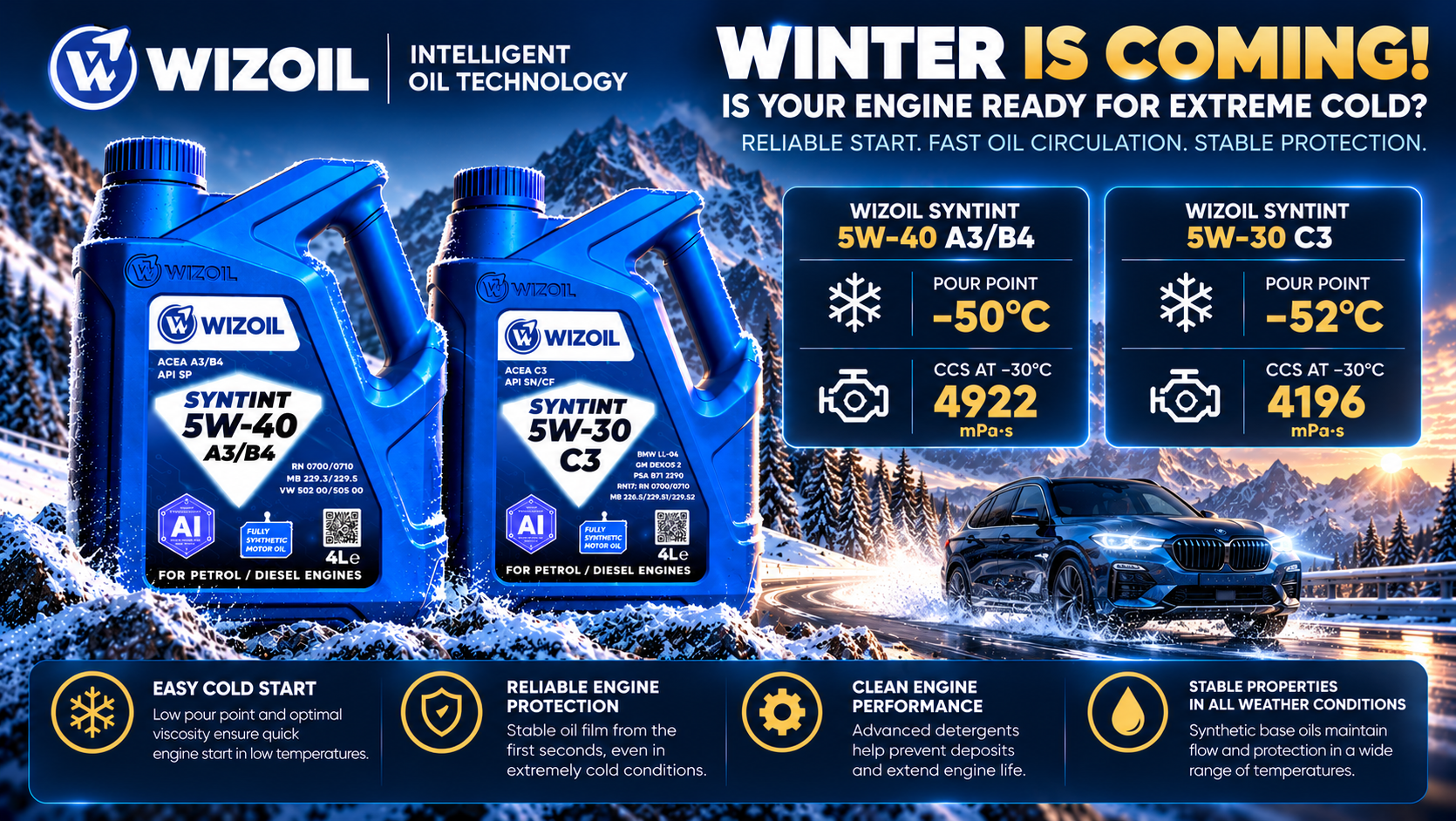
WINTER IS COMING! Is Your Engine Ready for Extreme Cold?
−50°C and −52°C: Outstanding Pour Point Results for WIZOIL SYNTINT Motor Oils. Cold Cranking Simulator (CCS) testing also confirms their excellent low-temperature performance.
As winter approaches, drivers increasingly focus on battery condition, winter tires, and the reliability of their vehicle's starting system. However, another critical factor influences engine performance in freezing conditions: choosing the right motor oil. At low temperatures, engine oil becomes more viscous, increasing the effort required to turn the crankshaft. At the same time, delivering lubricant to critical engine components becomes more challenging. That is why evaluating winter performance requires more than simply checking an oil's SAE viscosity grade. Actual laboratory test results provide valuable insight into its low-temperature properties.
Two Key Indicators of Winter Motor Oil Performance
1. Pour Point
The pour point is a laboratory-measured characteristic indicating the lowest temperature at which an oil continues to flow under specified test conditions. The lower the pour point, the lower the temperature at which the oil retains its ability to flow. However, the pour point should not be confused with the minimum temperature at which an engine can reliably start. An oil may remain capable of flowing while already presenting considerable resistance to crankshaft rotation.
2. Cold Cranking Simulator (CCS) Viscosity
CCS viscosity is one of the most important motor oil characteristics for winter operation. It measures the apparent viscosity of an oil at low temperatures and helps assess the resistance the lubricant creates during engine cranking. The lower the CCS value at the same test temperature, the less viscous resistance the oil presents during cold cranking. For oils classified as SAE 5W, the SAE J300 standard specifies a maximum CCS viscosity of:
6,600 mPa·s at −30°C. This parameter provides an objective basis for evaluating motor oil performance during cold engine starts.
WIZOIL: Latest Laboratory Test Results
WIZOIL SYNTINT 5W-40 A3/B4 and WIZOIL SYNTINT 5W-30 C3 have demonstrated excellent low-temperature characteristics in laboratory testing.
|
Parameter |
WIZOIL SYNTINT 5W-40 A3/B4 |
WIZOIL SYNTINT 5W-30 C3 |
|
Pour Point |
−50°C |
−52°C |
|
CCS Viscosity at −30°C |
4,922 mPa·s |
4,196 mPa·s |
|
SAE J300 Maximum CCS Limit for 5W |
6,600 mPa·s |
6,600 mPa·s |
|
Margin Below the CCS Limit |
25.4% |
36.4% |
The values shown are based on laboratory testing of the respective WIZOIL motor oil samples. Both products achieved CCS viscosity values significantly below the maximum permitted for the SAE 5W classification.
For WIZOIL SYNTINT 5W-40 A3/B4, the measured CCS viscosity was 25.4% below the specified limit, while WIZOIL SYNTINT 5W-30 C3 achieved a result 36.4% below the limit.
These results confirm the strong cold-cranking characteristics of both formulations.
WIZOIL SYNTINT 5W-40 A3/B4 — Dependable Protection in Winter Conditions
Pour Point: −50°C, CCS Viscosity at −30°C: 4,922 mPa·s
WIZOIL SYNTINT 5W-40 A3/B4 is a synthetic motor oil designed for gasoline and diesel engines requiring the appropriate viscosity grade and performance specifications. Its low pour point demonstrates the oil's ability to retain flow characteristics under severe cooling conditions. The CCS result of 4,922 mPa·s at −30°C confirms relatively low resistance to cold cranking compared with the maximum permitted value for SAE 5W oils. At normal engine operating temperatures, its SAE 40 viscosity grade provides the viscosity characteristics required for engines designed to use this grade. The product is formulated to meet the stated requirements of API SP and ACEA A3/B4, as well as VW 502 00/505 00, MB 229.3/229.5, and Renault RN 0700/0710 specifications.
WIZOIL SYNTINT 5W-30 C3 — Advanced Technology for Cold Starts
Pour Point: −52°C, CCS Viscosity at −30°C: 4,196 mPa·s.
WIZOIL SYNTINT 5W-30 C3 is a synthetic motor oil formulated for engines requiring ACEA C3 performance characteristics, including compatibility with applicable exhaust aftertreatment systems. Its pour point of −52°C demonstrates excellent low-temperature flow properties. Particularly noteworthy is its CCS viscosity result: 4,196 mPa·s at −30°C. This is 2,404 mPa·s below the SAE J300 maximum for the 5W viscosity grade.
These characteristics make the product a compelling option for winter operation in vehicles whose manufacturers specify SAE 5W-30 oils meeting ACEA C3 and the relevant OEM requirements. The product fully complies with the stated requirements of API SN/CF, ACEA C3, as well as the specifications BMW LL-04, GM dexos®2, MB 226.5/229.51/229.52, RN 0700/0710, RN 17, PSA B71 2290.
Why Is Low CCS Viscosity So Important in Winter?
During a cold start, engine oil creates resistance to the movement of internal components. The higher its viscosity at low temperatures, the greater the effort required from the starter motor. A lower CCS viscosity helps reduce viscous resistance during engine cranking, particularly in freezing conditions. This offers several practical advantages:
- Easier cold cranking. Lower oil resistance helps the starter motor turn the engine in cold weather.
- Reduced demand on the starting system. This is especially important when low temperatures limit battery performance.
- Verified low-temperature characteristics. CCS testing allows motor oils to be evaluated using measured performance data rather than SAE viscosity markings alone.
However, the speed at which oil reaches critical engine components also depends on its low-temperature pumpability, measured using the Mini-Rotary Viscometer (MRV), as well as the engine's lubrication system design and mechanical condition. Therefore, CCS viscosity is an essential but not exclusive indicator of winter oil performance.
Five Essential Tips for Preparing Your Engine for Winter:
- Follow your vehicle manufacturer's recommendations. Always select motor oil based on the specified SAE viscosity grade, ACEA and API performance categories, and relevant OEM requirements.
- Pay attention to CCS viscosity. Two oils with the same SAE 5W classification may exhibit different measured cold-cranking viscosities.
- Consider the pour point. This provides additional insight into the oil's low-temperature flow characteristics.
- Maintain your engine properly. Follow the recommended oil change intervals and servicing requirements.
- Check your battery and starter motor. Reliable winter starting depends on the condition of the entire starting system.
WIZOIL — Intelligent Engine Protection in Every Season.
Winter driving places increased demands on motor oil performance. Advanced synthetic oil technology makes it possible to combine effective protection at normal operating temperatures with the low-temperature properties required for cold-weather operation.
WIZOIL laboratory test results demonstrate:
WIZOIL SYNTINT 5W-40 A3/B4
- Pour Point: −50°C
- CCS Viscosity at −30°C: 4,922 mPa·s
WIZOIL SYNTINT 5W-30 C3
- Pour Point: −52°C
- CCS Viscosity at −30°C: 4,196 mPa·s
WINTER IS COMING! Prepare your engine for freezing temperatures. Choose WIZOIL — intelligent engine protection backed by laboratory testing.
WIZOIL — Intelligent Oil Technology